
In PEP 498 a new string formatting mechanism was introduced called as "Literal String Interpolation" or more famously called as f-strings.
The Python f-strings are a way by which you can embed expressions inside string literals. It makes use of a very minimal syntax (prefixed with the word 'f').
Let us take a look at the Syntax:
f"Some String Literal {expression-1} more text {expression-2}"Note: The f-string literal string expressions are evaluated at run-time, and they are expressed with curly braces as shown above.
Examples:
Example 1:user = 'Mike'
f'The user name is {user}''The user name is Mike'
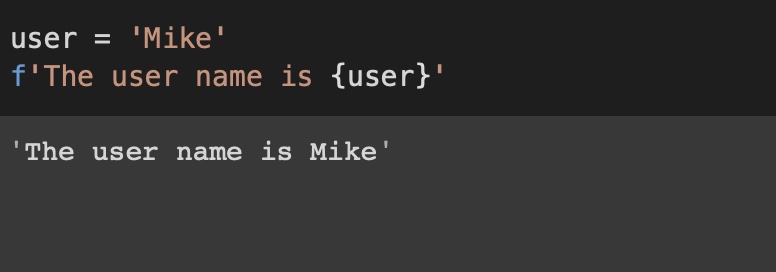
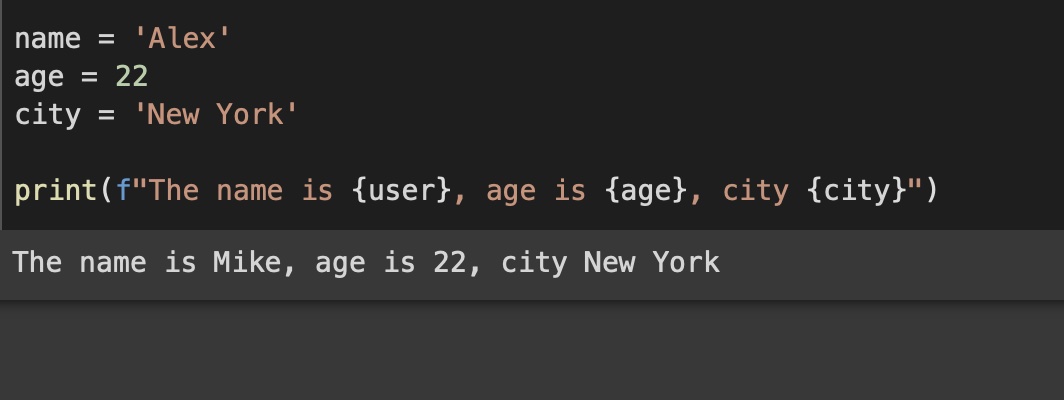
Example 2: f-strings with print function
name = 'Alex'
age = 22
city = 'New York'

print(f"The name is {user}, age is {age}, city {city}")The name is Mike, age is 22, city New York
The f-string was designed with the intention to have a simpler way to format strings in Python as the existing ways of formatting are either error-prone, inflexible, or cumbersome.
Further readings:
Provide Feedback For This Article
We take your feedback seriously and use it to improve our content. Thank you for helping us serve you better!
😊 Thanks for your time, your feedback has been registered!
Comments & Discussion
Facing issues? Have questions? Post them here! We're happy to help!