
Introduction
- Introduction
- Usage
- Syntax
- What does pwd command do?
- Option -L
- Option -P
- Where is pwd binary located?
- Exit codes
- Conclusion
One of the very first commands that one learns when starting with Linux or Unix Operating Systems is the pwd command.
pwd stands for print working directory.
It is a shell built-in general-purpose command.
Usage:
To display the current working directory nameSyntax:
pwd [-L | -P]What does pwd command do?
When you execute the pwd command on any shell prompt, it will print to the standard output (stdout) the name of the current directory that the user is in.
The name is displayed starting from the root directory (i.e. the / (slash) at the start of the name) followed by slashes that denotes separation between directories (nested directories)
The name after the last slash is the name of your current directory you are in.
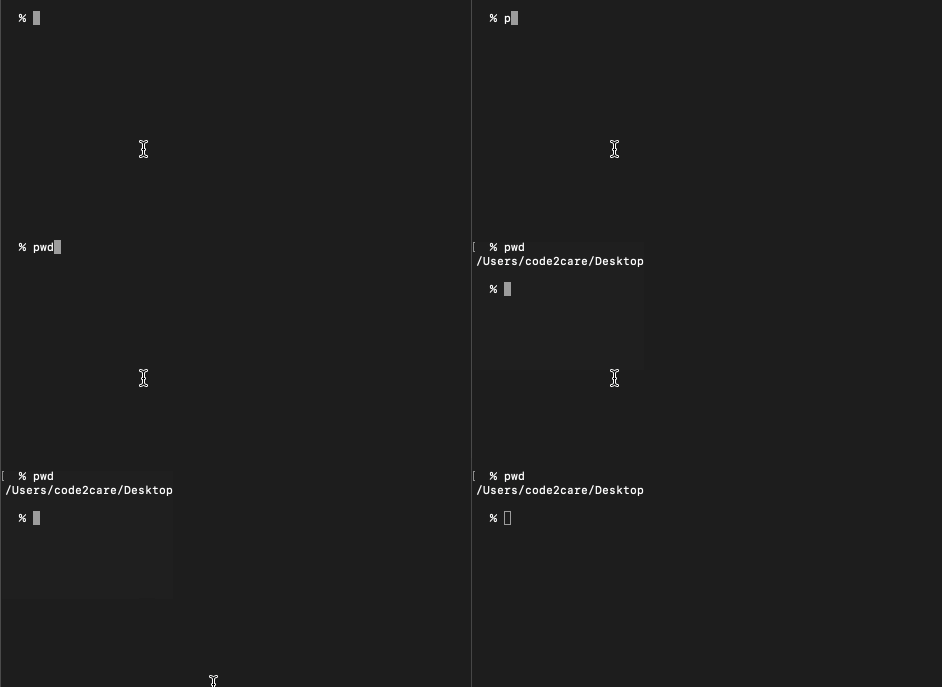
Example 1:# pwd
/Users/code2care/DesktopIn the above example Desktop is the current directory located within User -> code2care.
Example 2:# pwd
/If you just get / as output then you are in the root directory.
Options:
There are only two options that you can use with the pwd command i.e. -L and -P
-L (--logical)When -L option is used with pwd command it will display the logical current working directory, which is the value of the PWD environment variable.
Example 3:# pwd -L
/home/mydirs-P (--physical)
When -P option is used with the pwd command it will display the symbolic link if it is associated with the current directory, if not, it will simply print out the PWD value as with -L option.
Example 4:# cd /home/mydirs
# pwd -P
/home/dir1/dir2/dir3As you can see in the above example, we changed the directory to /home/mydirs which is actually a symbolic link to /home/dir1/dir2/dir3 hence -P options prints out /home/dir1/dir2/dir3 instead of /home/mydirs.
Note: The -L option will not work if the PWD environment variable is exported by the shell.
Where is pwd binary located?
The pwd file/binary is located in /bin/pwd
Error codes associated with PWD command
0 -> success
> 0 -> an error occurs
If you provide an incorrect option/flag, you will get an error,
# pwd -A
pwd: bad option: -A
# pwd -X
bash: pwd: -X: invalid option
pwd: usage: pwd [-LP]
Conclusion
To know where are you currently when working on a Terminal Shell, make use of pwd command. Use -P option to know the real physical location of the current directory.
Provide Feedback For This Article
We take your feedback seriously and use it to improve our content. Thank you for helping us serve you better!
😊 Thanks for your time, your feedback has been registered!
Comments & Discussion
Facing issues? Have questions? Post them here! We're happy to help!