
Java is called a hybrid-programming language or not a truly object-oriented language as it supports primitives. Working with primitives may not be easy as it may seem as incorrect type conversions can create havoc!
In Java, when we convert a larger data type such as a double, long to a smaller one such as an int, short, byte, char this process is called "narrowing primitive conversion" which this can result in loss of precision.
Let us take a look at a few ways to convert a Java int type to a primitive long.
Example 1: By Type-casting to int (not recommended)
Code: public static void main(String[] args) {
long myLong = 20L;
int myInt = (int) myLong; //typecasting
System.out.println(myInt);
}Output: 20
This may look good, but there is a serious problem that can arise here. int in Java are of 4-bytes and it can hold values between the range -2147483648 to 2147483647, whereas long have a size of 8-bytes so they can hold a signed value of range -9223372036854775808 to 9223372036854775807
So let's try the above code with a value of long as 922337203685.
    public static void main(String[] args) {
        long myLong = 922337203685L;
        int myInt = (int) myLong;
        System.out.println(myInt);
}-1080764955
Example 2: Using toIntExact() method from java.lang.Math package.
toIntExact() method was introduced in Java 8, this is the proper way of typecasting a long to long to int.
Code:import static java.lang.Math.toIntExact;
public class Main {
public static void main(String[] args) {
long myLong = 922337203685L;
int myInt = toIntExact(myLong);
System.out.println(myInt);
}
}Exception in thread "main" java.lang.ArithmeticException: integer overflow
at java.base/java.lang.Math.toIntExact(Math.java:1371)
at Main.main(Main.java:7)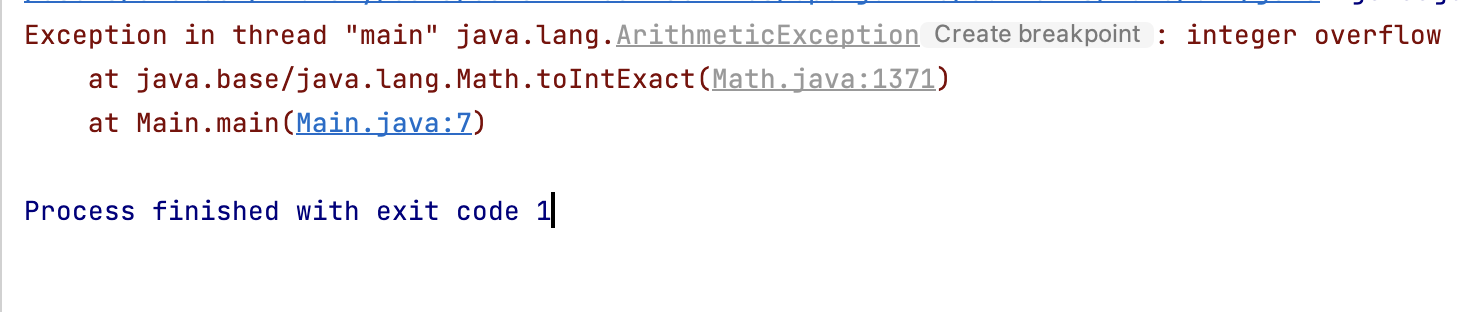
Provide Feedback For This Article
We take your feedback seriously and use it to improve our content. Thank you for helping us serve you better!
😊 Thanks for your time, your feedback has been registered!
Comments & Discussion
Facing issues? Have questions? Post them here! We're happy to help!